
Statistics

Tag: statistics

Comparing Single Column, Multi-Column, and Filtered Statistics in SQL Server

Comparing Single Column, Multi-Column, and Filtered Statistics in SQL Server

Statistics in SQL Server are simple in theory: they help the optimizer estimate how many rows a query might return.

In practice? Things get weird fast. Especially when you start filtering on multiple columns, or wondering why the optimizer thinks millions of rows are coming back when you know it’s more like a few hundred thousand.

In this post, I’ll walk through examples using single-column, multi-column, and filtered statistics—and show where estimates go off the rails, when they get back on track, and why that doesn’t always mean you need to update everything with FULLSCAN.

Continue reading

Slow Storage Can Cause Slow Compilation Time in SQL Server

Slow Storage Can Cause Slow Compilation Time in SQL Server

Up till now, I’ve thought of compilation time in SQL Server as being dependent only on CPU resources– not something that requires fast storage to be speedy. But that’s not quite right.

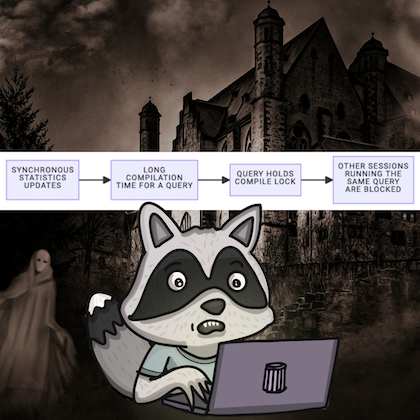
Slow storage can result in periodic long compile time in SQL Server. And long compile time not only extends the runtime for the query, it can also result in blocking with waits for compile locks.

Thanks to Erik Darling for helping me figure this out, and explaining this all in his video, What Else Happens When Queries Try To Compile In SQL Server: COMPILE LOCKS!. For great details and demos, go watch that! I’ll be working through the topic with some simple flow charts here.

Continue reading

Should You Use SQL Server Readable Secondaries If Queries Can Fail Repeatedly at Any Time?

Should You Use SQL Server Readable Secondaries If Queries Can Fail Repeatedly at Any Time?

If you use readable secondaries in Availability Groups or Read-Scale out instances in Azure SQL Managed Instance, you may have queries fail repeatedly if there is a glitch and statistics are not successfully ‘refreshed’ on the secondary replica. Those queries may keep failing until you manually intervene.

It’s unclear if Microsoft will ever fix this. There is a well established support deflection article which documents the issue and provides ‘workarounds’.

Continue reading

Are Bad Statistics Making My Query Slow? (Dear SQL DBA Episode 39)

Are Bad Statistics Making My Query Slow? (Dear SQL DBA Episode 39)

An important query is suddenly slow. Is it because statistics are out of date? This is tricky to figure out, and updating statistics right away can make troubleshooting even harder. Learn how to use query execution plans to get to the heart of the question and find out if stats are really your problem, or if it’s something else.

In this 35 minute episode:

  • 00:39 SQL Server 2017 Announced
  • 01:10 New video from Microsoft’s Joe Sack demonstrating Adaptive Query Processing
  • 03:05 This week’s question: Are bad stats making my query slow?
  • 05:26 Demo of finding plan in cache and analyzing stats begins
  • 28:17 What to do when stats ARE the problem

Code samples are at the bottom of the page

Continue reading

Bug: Incorrect modification_counter for Column Stats on Tables with a Clustered Columnstore Index

Bug: Incorrect modification_counter for Column Stats on Tables with a Clustered Columnstore Index

I don’t find bugs in SQL Server all that often. I find bugs in my own code all the time.

In this case I double checked, and I think it’s a real SQL Server bug.

Continue reading

Does Truncate Table Reset Statistics?

Does Truncate Table Reset Statistics?

Short answer: the SQL Server optimizer will know that the table was truncated, but statistics might not update when you expect.

For the long answer, let’s walk through an example using the WideWorldImporters sample database.

Continue reading