Query-Store

Tag: query-store

Finally, a SQL Server Monitoring System That Leverages Query Store

Finally, a SQL Server Monitoring System That Leverages Query Store

I’ve spent a bit of time with Microsoft’s new database watcher tool for Azure SQL recently.

There are a lot of things I like about database watcher– which is currently in preview and which refuses to Capitalize Its Name– but it does one big thing that I really, really like: it collects data from Query Store. You can access that Query Store data from built-in database watcher dashboards, query it using KQL, or (something something) in Microsoft Fabric if you’ve got money to burn on your monitoring data.


Continue reading

Query Store Size Based Cleanup Causes Performance Problems - How to Avoid It

Query Store Size Based Cleanup Causes Performance Problems - How to Avoid It

I’m a huge fan of SQL Server’s Query Store feature. Query Store collects query execution plans and aggregate query performance metrics, including wait stats. Having Query Store enabled makes troubleshooting performance issues such as bad parameter sniffing, much, much easier. Because Query Store is integrated into SQL Server itself, it also can catch query plans in a lightweight way that an external monitoring system will often miss.

When performance matters, it’s important to ensure that you’re managing Query Store so that Query Store cleanup does not run during high volume times. Query Store cleanup could slow your workload down significantly.

Continue reading

You Will Not Find Long Compilers Who Time Out in Query Store

You Will Not Find Long Compilers Who Time Out in Query Store

Last November, a puzzle was really bothering me. Some queries from an application were timing out frequently after running for 30 seconds, but they were halfway invisible in the SQL Server.

Continue reading

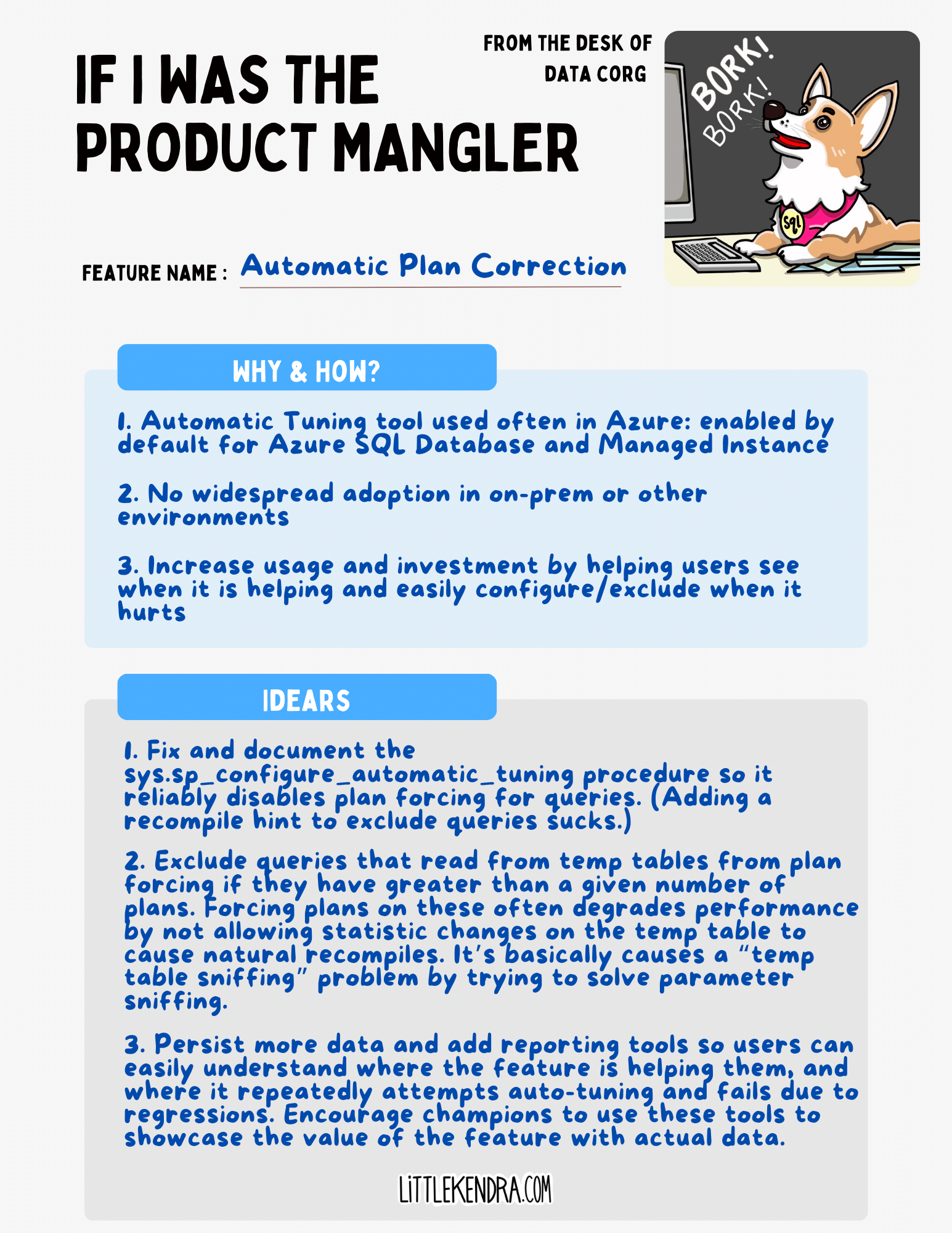
Automatic Plan Correction Could Be a Great Auto Tuning Feature for SQL Server: Here Is What It Needs

Automatic Plan Correction Could Be a Great Auto Tuning Feature for SQL Server: Here Is What It Needs

🔥 UPDATE: The sys.sp_configure_automatic_tuning stored procedure is now documented and supported by Microsoft. Thanks to the SQL Server Product team for this improvement.

I’ve written a bit about SQL Server’s Automatic Plan Correction feature before– I have an hour long free course with demos on Automatic Plan Correction here on the site.

Today I’m updating that course with a note: after using Automatic Plan Correction in anger for a good amount of time, I do not recommend enabling the feature. I’ve had it cause too many performance problems, and there are not a ton of options for an administrator when it’s causing those problems.

Meanwhile, becoming reliant on the feature for the places where it does help makes it difficult to disable the feature. You end up stuck with a very weird set of problems that are oddly similar to the problems the feature was designed to solve.

Further investment in the feature could solve these problems and make this a great tool for customers. Here’s a run down of what Automatic Plan Correction needs from a user who has suffered from it.

Continue reading

Microsoft is Breaking Database Compatibility Levels for SQL Server

Microsoft is Breaking Database Compatibility Levels for SQL Server

According to Microsoft’s documentation, ‘Database compatibility level … allow[s] the SQL Server Database Engine to be upgraded while keeping the same functional status for connecting applications by maintaining the same pre-upgrade database compatibility level."

But these days, the “functional status” of a database at a given compatibility level differs depending on whether you’re using SQL Server, Azure SQL Managed Instance, or Azure SQL Database – and in the hosted versions it may change anytime without notice. Surprise, your database behaves differently now!

The whole concept is breaking down, and this is bad news for users of both managed services and the boxed product.

Continue reading

How Many Features Are Missing from Azure SQL Managed Instance?

How Many Features Are Missing from Azure SQL Managed Instance?

🔥 UPDATE (November 2025): Since this post was written, most Intelligent Query Processing features are now available.
  • According to Microsoft documentation, most Intelligent Query Processing features are now available in Azure SQL Managed Instance, including Cardinality Estimation Feedback, Memory Grant Feedback (percentile), and Parameter Sensitivity Plan Optimization. Some features require specific database compatibility levels.
  • Storage increases: Business Critical service tier now supports up to 16 TB of storage (increased from 4 TB), and the new Next-gen General Purpose service tier supports up to 32 TB. See resource limits documentation for details.
  • Next-gen General Purpose (GPV2) improvements: The new Next-gen General Purpose service tier eliminates the need to configure abnormally large file sizes to get IOPS and throughput. This limitation only applied to the original General Purpose (GPV1) tier, where file sizes determined IOPS and throughput allocation.
Still missing: The following features remain unavailable in Azure SQL Managed Instance as of November 2025, along with most of the features in the post not listed above.

Spoiler: a large amount of features from SQL Server 2022 are missing from Azure SQL Managed Instance. Some major features are missing that were introduced in SQL Server 2019– and here we are just a few weeks away from 2024.

But Microsoft’s top-line marketing claims about Azure SQL Managed Instance remain that ‘it’s always up to date with the latest SQL features and functionality.’

Let’s dig into some of the documented highlights on missing features, so you can decide for yourself what to think of that statement.

Continue reading

New Article on Performance Tuning with the Missing Indexes Feature in SQL Server

New Article on Performance Tuning with the Missing Indexes Feature in SQL Server

We’ve just published a new article in the SQL docs, Tune nonclustered indexes with missing index suggestions . The article explains what the missing index feature is, limitations of the feature, and how to use missing index DMVs and missing index suggestions in Query Store to tune indexes.

Continue reading