Merge

Tag: merge

Adding Partitions to the Lower End of a Left Based Partition Function

Adding Partitions to the Lower End of a Left Based Partition Function

I recently got a table partitioning question from a reader:

We now need to load some historical data into the table for 2013 so I want to alter the function and schema to add monthly partitions for this. But I can’t work out how to do this using SPLIT? Every example and tutorial I’ve looked at shows how to add new partitions onto the end of a range, not split one in the middle.

Continue reading

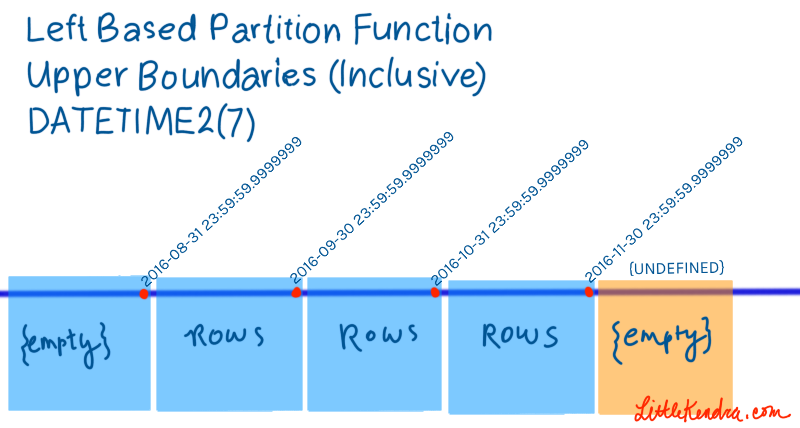
Understanding Left vs. Right Partition Functions (with Diagrams)

Understanding Left vs. Right Partition Functions (with Diagrams)

You’re designing table partitioning, or you want to make a change to an existing partition function. It’s critical to understand the difference between how “left” and “right” partition functions behave, but the documentation is a bitย confusing on this topic.

Continue reading

Which Filegroup is that Partition Using? How Many Rows Does It Have?

Which Filegroup is that Partition Using? How Many Rows Does It Have?

Table Partitioning in SQL Server has a bit of a learning curve. It’s tricky to just figure out how much data you have and where the data is stored.

Continue reading

Merging Boundary Points: Does a Changing Partition_Number Indicate Data Movement?

Merging Boundary Points: Does a Changing Partition_Number Indicate Data Movement?

I received a question from a reader who was testing out a partitioning architecture:

We are testing table partitioning using one filegroup per partition. When we merge a boundary point, we see that partition_number changes in sys.partitions.ย Does this mean that data movement is occurring?

Continue reading

The Case of the Blocking Merge Statement (LCK_M_RS_U locks)

The Case of the Blocking Merge Statement (LCK_M_RS_U locks)

Recently I got a fun question about an “upsert” pattern as a “Dear SQL DBA” question. The question is about TSQL, so it lent itself to being answered in a blog post where I can show repro code and screenshots.

Continue reading