
What the Decline of SQL Server Quality Means for Developers and DBAs
‘Is it just me, or is SQL Server quality slipping?’
I asked myself that question for couple/few years until I faced up to it: SQL Server …
Read MoreBy Kendra Little on • 20 min read
Amid the global pandemic, online tech conferences have had a natural surge in popularity. I’ve attended quite a few of these in 2020 across several technical areas (database tech, DevOps, privacy, tech research). The conferences have been both large and small, both free and paid, and have been held across a few different regions and time zones.
Many things have gone well. Organizations who are used to doing in-person events have worked hard to quickly adapt to online platforms, and I’ve seen some fantastic content. This is terrific!
But there are a few critical things that haven’t adapted well in the transition to online events. I’ve seen some major problems occur consistently across all these tech conferences. This isn’t due to laziness or lack of trying – it’s simply that some patterns that work at physical events don’t work well at online events.
We are learning as we go.
With creativity we can massively improve the experience of online events – and that’s really worth doing! Please help brainstorm and share your own ideas about how to make online conferences more awesome.
My favorite thing about online conferences is that they are generally far more accessible and open than in-person events.
Travel and hotel costs for in-person events are often significant, and only those who are already in quite Senior roles typically have the benefit of these being paid by their employer. Ticket prices for in-person conferences are also generally higher, and less privileged community members similarly have a more difficult time getting these funded, often needing to pay out of their own pockets.
I also believe that low cost and free online events may create more open communities, as there is relatively low risk for someone new to the community to try out the event for a short time. Online spaces may feel safer for members of marginalized groups in terms of testing the waters to find out what a community is all about. This can result into bringing fresh ideas and many new people into the community, both in terms of those who are new to working in tech and in terms of those who specialize in other areas.
For these reasons, even if we are able to get back to in-person events quite soon, I have hopes that online tech events will continue to be a stronger presence than they were prior to the COVID-19 pandemic.
To do this, we need to solve some important problems about funding community and professional conferences, as well as improve the participant experience.
Most community and professional tech events, both free and paid, rely on sponsors to lower costs for attendees. Platforms for online events and staff to help organize and carry out the event cost real money, so this is still incredibly relevant for online events.
I’ve seen event after event attempt to replicate the ‘Vendor Expo Hall’ of an in-person tech conference. And at event after event, I have seen minimal to no engagement – I’ve yet to see or hear about ‘Vendor Booths’ working in an online format. After all, there’s no good online way to replicate the ways that events have made the Vendor Expo Hall more fun at physical events: free toys and swag, tasty food and drinks, games and magicians and entertainment which can take place right next to personal, real-world conversations.
Here are some things I’ve seen which didn’t work well. If you’re going to try them, change them up a bit to avoid known pitfalls:
I’ve been part of conferences which have worked on building engagement in quite a few ways, which is great – but none have been great at helping participants create meaningful connections with speakers, each other, and sponsors. Here’s what I’ve seen tried:
Most conferences have kept similar time frames and flow of sessions as they’ve moved into online events. However, the attendee experience is different: there’s no physical movement between sessions. There’s no change of scenery. And it’s often even harder for participants to disconnect fully from their work: they end up checking emails frantically during breaks, in early mornings, and in evenings.
Ideas: Mixing up “types” of sessions between more passive learning and interactive sessions will help a bit (but not do the whole job)
Experimenting with different “tempos” for online event days is important for conference organizers.
Experiment with more partial-day events rather than only full-day sessions. Could an online platform even allow you to have an event across more than one week?
Part of this is mindset for the organizers: resist the urge to believe that the selling point of your conference is a relentless bombardment of information across multiple tracks. Focus on maximizing the value participants will take away instead, which means helping them absorb information and have some time away from the conference screen.
Those are the three biggest problems I’ve seen.
Now for the fun part: ideas on how to make this more sustainable, more rewarding for participants, and more awesome!
These are numbered, but not ranked.
1. More Birds-of-a-Feather Chats, and Work In Your Sponsors - One thing I’ve seen that worked very well was mixing regular time periods into the conference schedule where conference attendees were invited to join live small-group discussions led by a moderator. Multiple discussions on different topics were live at each time. These were held in a format that allowed attendees to share webcams and microphones. Moderators came prepared with a list of questions and topics to spark the discussion.
This helps attendees have time for more meaningful engagements. The difference in format between this and a more passive learning session provides a needed change of pace. And you also have the option of inviting your vendors to participate in these, particularly the topics which are related to their mission and areas of interest. (This doesn’t necessarily mean doing demos or selling products, but rather being part of the discussion.)
2. Workshops, some Sponsored - I’m not going to lie, workshops ain’t easy to do well, whether in-person or online. But these are absolutely worth experimenting on, as when they are great they are amazing for your participants. Some notes:
3. Commercial Contests - I know, especially for paid conferences, attendees may not love the idea of seeing sponsor commercials as part of the main conference track. But what if you gamified this for your sponsors, and added a contest for your attendees related to it? This could be really fun.
4. Prizes for Meaningful Engagement - As I mentioned above, I’ve seen simple scavenger hunts fail miserably. Just “visiting” a vendor booth in an online world doesn’t make for engagement with the vendor. Why not change the contest up? Your conference platform needs to provide some way of interacting with sponsors, whether it’s by chat room, video chat, or even email options. Ideas to hype throughout your conference to encourage engagement:
5. Help Vendors Learn and Create Leads - Why would vendors want to sponsor community and professional events when they can run their own online events at a pretty low cost and gather all the leads they want? The answer is that vendors want to find new potential customers and to learn about where customers are going in the marketplace.
In other words, conferences can work to help vendors with both short term and longer term goals. Successful vendors understand that building their brand over time is important. They understand that learning about potential customers, their pain points, their perspectives, their goals, is key to their survival. Ideas:
6. Ideas to Overcome “Awkward Chat Room” Experiences - I know quite a few folks who hate awkward silences in online meetings. It makes their skin crawl. I know others who feel very shy at speaking up in an online session. Others who can’t stand turning on webcams.
And then there’s the problem of having 12 people in a video room, and everyone starts talking at once, then apologizing. There’s That Person who can’t help dominating the discussion. There’s so many ways that things can get awkward.
And also, let’s face it, video calls get super boring real fast these days. Ideas to make it more interesting:
7. Pre-Recorded Sessions, Live Q&A After - Many conference organizers like to have some or all the sessions at an online event available in a recording ahead of time. This helps them ensure that the show will go on, no matter what technical problems ensue. (See my note above about the importance of mentioning your recording requirements when you do your call for speakers.)
I understand the appeal of pre-recorded sessions at a very personal level, having had my home internet stop working completely on the first day of a three day conference recently. I was working off a series of not-great-bandwidth cellular devices until it was repaired by line crews outside my home EXACTLY as the conference ended on the last day. My sessions were 100% saved by the fact that I’d pre-recorded them.
But as I mention above, it’s a huge challenge for attendees to multi-task and learn at the same time. I’ve yet to see a platform where a presenter could pause a pre-recorded session to handle a question live. Instead, chat and Q&A flows past while the session marches forward.
Part of the solution longer term involves explaining this challenge to conference platforms, and asking them for ideas to solve it. In the meantime, adjust your session timings accordingly!
8. Shorter Days, Longer Events - I know event organizers are used to going flat out for a few days and then wrapping everything up. That makes sense when people need to travel to attend your event. But the game is very different with online events, and it’s time to change tempos.
In teaching online courses over the years prior to the pandemic, I learned that shorter sessions spread across more days helped attendees learn more:
This is going to be a big mindset change for organizers in terms of marketing. Conference organizers are used to advertising on being the “biggest” conference with the most concurrent sessions. But with this approach, attendees leave your event feeling burnt out and strangely lonely. Will that bring them back?
A key part of improving attendee experience in online conferences will be experimentation with both session formats and conference timing. Think about how to help your attendees have the best experiences with new scheduling patterns.
9. Plan Carefully for Multi-Timezone Events - Timezones are hard, y’all. They’re hard when planning an event, and they’re hard when attending an event.
If you are an event organizer and are evaluating an online platform, a critical thing to evaluate is how the platform presents times to people who may be watching from different timezones. How easy is it for people to understand when sessions begin and end? It needs to be super easy.
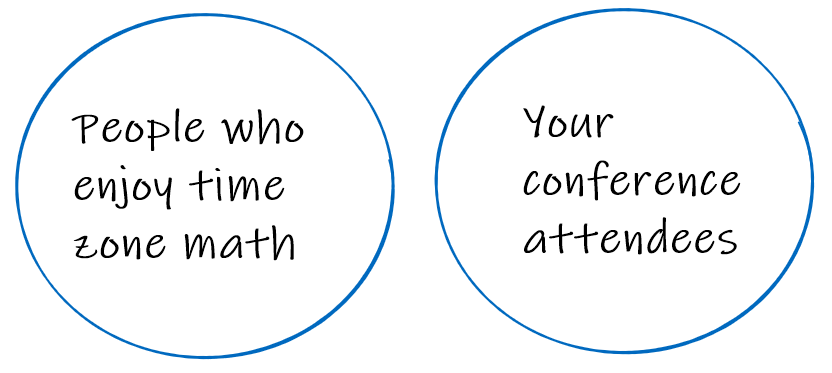
Assume that the group of people who enjoy time zone math does not at all overlap with the group of people attending your event.
Depending on what technology you have to work with, you may not have a “perfect” option as an organizer. But do your best to try to provide whatever workarounds you can to make your attendees from different time zones feel at home. And express how important this is to the people who make virtual event platforms, please. This is a courtesy your guests will notice!
10. Be Clear – But Not Paranoid or Greedy – About Vendor Sessions - This is a funny one, because it’s more of an issue in some tech circles than in others. In both DevOps and Privacy themed conferences, it’s fairly normal for vendors to give sessions which feature how their products work. The sessions are typically clearly labeled so you know what you’re going to see. It’s not a big deal.
This is a good model for others to embrace. Offer sponsoring vendors the chance to give sessions explaining how their solutions give value. Clearly label the sessions so that attendees know what to expect and can choose accordingly.
This model actually works better in an online conference format than it does in an in-person one. Your sponsors will be highly aware of how easy it is to quietly and quickly leave an online session which is dull or generally unhelpful! There is none of the awkwardness of stepping through a row of people in a physical room to keep people there. The online format means that vendors need to bring relevance and value in these sessions, which is great for both attendees and conference organizers.
This is only ten ideas. There are many more! What we need is creativity.
I’d love to see tweets, blog posts, and LinkedIn articles about what you think will make online conferences more sustainable and better experiences.



Copyright (c) 2025, Catalyze SQL, LLC; all rights reserved. Opinions expressed on this site are solely those of Kendra Little of Catalyze SQL, LLC. Content policy: Short excerpts of blog posts (3 sentences) may be republished, but longer excerpts and artwork cannot be shared without explicit permission.