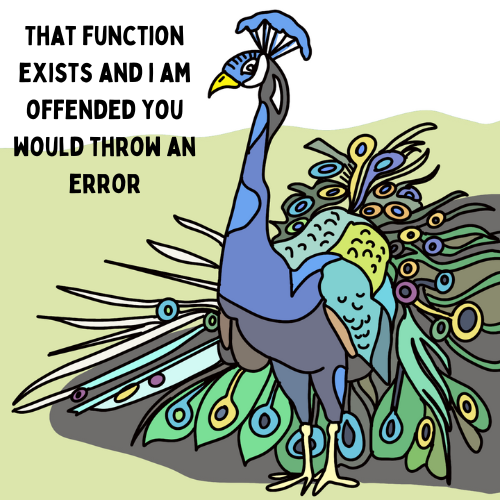
Msg 195: STRING_SPLIT Is Not a Recognized Built-In Function Name
Yesterday, I was writing some Transact SQL to dust off the cobwebs. I got confused when I was playing around with the STRING_SPLIT function, and kept …
Read MoreBy Kendra Little on • 3 min read
It’s T-SQL Tuesday’s 8 year birthday (or close enough), and Adam Machanic has challenged us with the question: what will the world be like when T-SQLTuesday turns 16?
Not familiar with T-SQL Tuesday? It’s a monthly event where you’re invited to join in blogging on a given topic. Invitations are posted centrally here, and here’s how to set up emails if you’d like the invitation in your inbox.
Individual servers, virtual machines, instances, databases - many of us will still know those concepts well and fondly. But most new applications will be written for and deployed on BAGIs.
Big BAGIs will be giant compute clusters, run by a variety of providers. These compute clusters won’t have any tape storage, no spinning disks, not even any SSDs as we know them today. Instead, they’ll be loaded with vast amounts of specialized memory, which achieves high availability by super fast networking between compute clusters in different datacenters.
Your BAGI may contain relational data, document data, graph data, or many more different types of data. Your applications will be able to access BAGIs of different types, and manipulate and process that data using Daemons – one of which is the SQL Server Daemon, whose binaries live on the Big BAGI. Different Big BAGI Daemons will have specialized optimization techniques and abilities to scale.
When you create a little BAGI, it will always live on one more more Big BAGI, and your writes to your BAGI are always written to both, with automatic conflict resolution.
How is the conflict resolution determined? You configure your BAGIs in groups, and each group of BAGIs has a data steward. On a contractual basis of your choosing, Cordelia (Cortana’s descendant), checks in with the data steward with a Q&A session on data retention, conflict resolution, and BAGI security, and cost management.
You have options. You can either pay by the gram – literally, the weight that the data takes up in memory, multiplied by a fluctuating currency charge – or if you want lower-latency data access, you can pay higher rates for bigger individual BAGIs, many BAGIs guaranteed to be in close proximity of one another, or a certain level of global redundancy of your BAGIs, having your BAGIs hosted on a minimum number of providers, etc.
Yes, data will have truly become our favorite cultural drug.

Copyright (c) 2025, Catalyze SQL, LLC; all rights reserved. Opinions expressed on this site are solely those of Kendra Little of Catalyze SQL, LLC. Content policy: Short excerpts of blog posts (3 sentences) may be republished, but longer excerpts and artwork cannot be shared without explicit permission.